Measured Constitutional Threat Assessment & Civic Briefing
Executive Summary
Islamism—defined as a political ideology that seeks to impose religious law through civil authority—is incompatible with the United States Constitution. This briefing distinguishes ideology from religion and emphasizes constitutional enforcement over fear-driven narratives.
Islamism as a Constitutional Issue (Not a Religious One)
Islamism conflicts with the U.S. Constitution because it rejects popular sovereignty, equal protection under the law, freedom of conscience, and civil authority independent of religious supremacy. This incompatibility is ideological, not religious.
What the Threat Is
• An ideological challenge to constitutional governance
• Comparable to other anti-constitutional systems such as theocracy or authoritarianism
• Addressable through neutral enforcement of existing law
What the Threat Is Not
• Not Muslims as individuals
• Not immigration itself
• Not private religious belief
• Not an inevitable historical outcome
Why Exaggeration Weakens Constitutional Defense
Fear-based historical narratives distort reality, alienate constitutional allies, and make legitimate enforcement appear reactionary. Precision strengthens credibility; exaggeration undermines it.
What History Actually Shows
• Islamic empires expanded aggressively in certain periods
• Expansion was not uniform, inevitable, or permanent
• Modern constitutional republics are not comparable to medieval societies
Modern Constitutional Risk Vectors
• Parallel legal systems framed as religious accommodation
• Blasphemy norms influencing civil regulation
• Foreign-funded ideological institutions
• Failure to enforce neutral law due to political pressure
Oklahoma’s Constitutional Advantage
Consistent Enforcement vs Fear Narratives
Oklahoma officials swear an oath to uphold only the U.S. Constitution and the Oklahoma Constitution. That oath requires neutral, consistent enforcement of civil law and prohibits any parallel system of authority from superseding constitutional governance.
Consistent enforcement means:
• Laws are applied equally without regard to religion, ideology, or identity.
• Private belief is fully protected, while public conduct remains subject to civil law.
• Religious or cultural arbitration may exist only voluntarily and may never override statutory or constitutional rights.
• Vulnerable individuals—women, minors, dissenters, and converts—are protected by civil authority first.
• Enforcement is routine, calm, and transparent, not reactive or crisis-driven.
Fear-based narratives fail because they shift attention from conduct to identity, discourage enforcement through political pressure, and erode public trust. Exaggeration weakens credibility and unintentionally shields real threats.
A confident constitutional republic relies on steady, even-handed application of the rule of law—not panic.
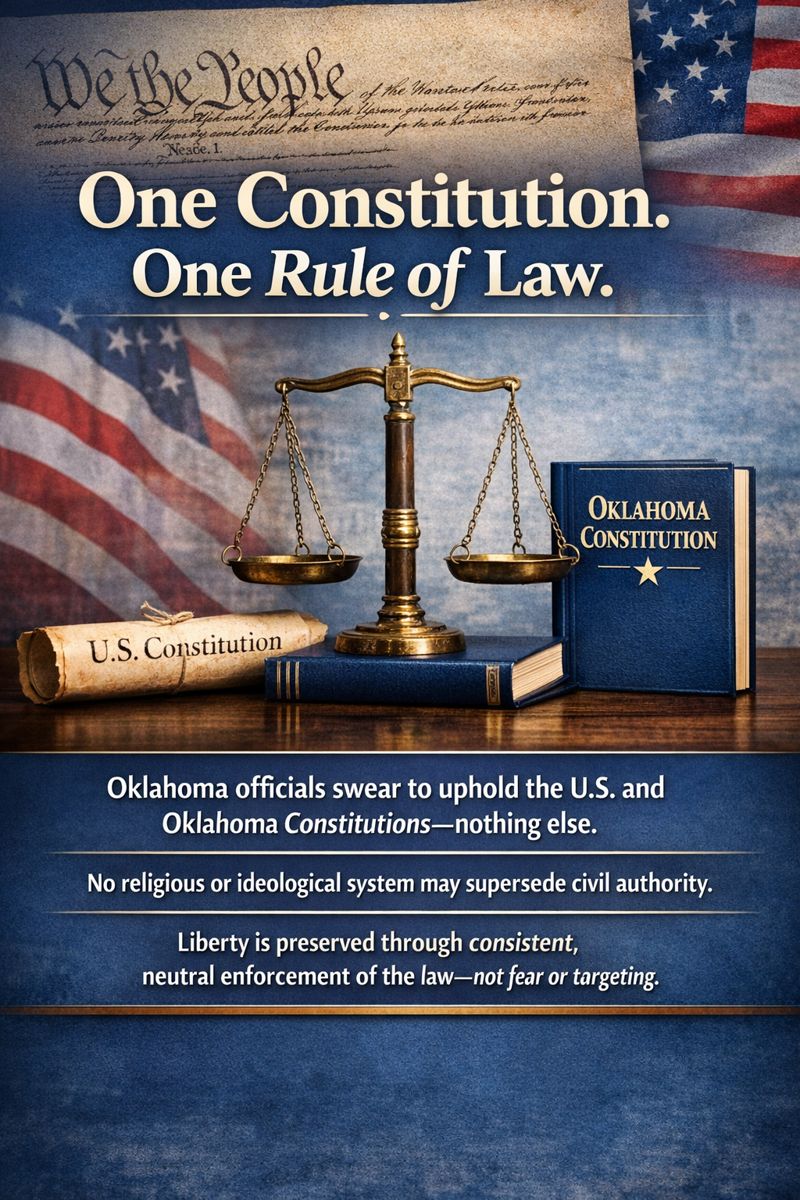
One Constitution. One Rule of Law.
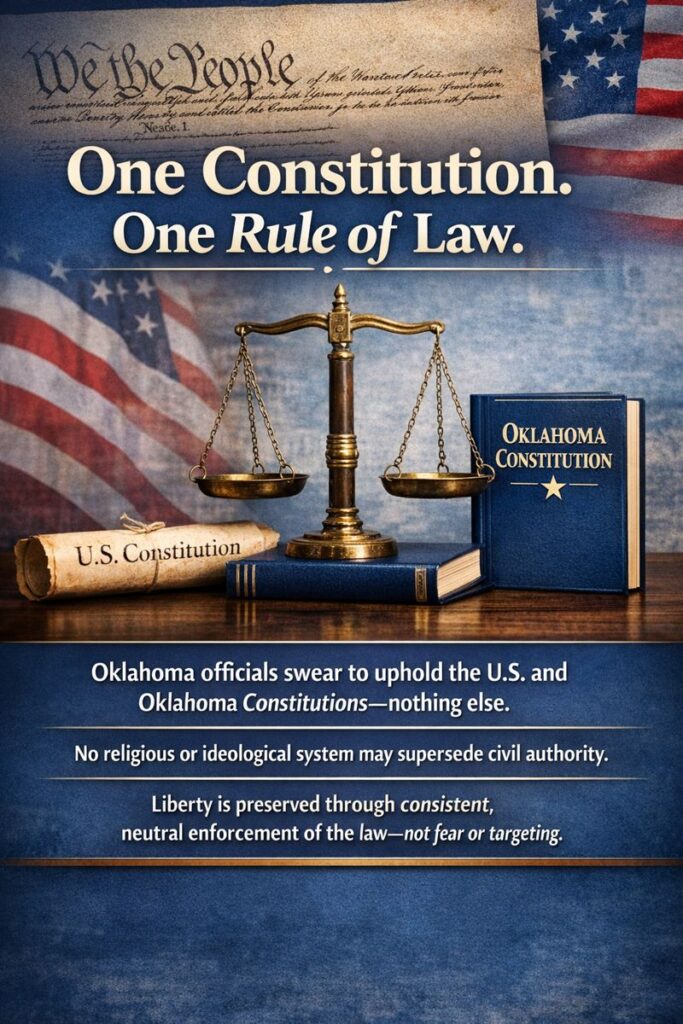
Oklahoma officials swear to uphold the U.S. and Oklahoma Constitutions—nothing else. No religious or ideological system may supersede civil authority. Liberty is preserved through consistent, neutral enforcement of the law—not fear or targeting.
Key Takeaway
The Constitution is strong enough to defeat any ideology that rejects it—provided it is defended with clarity rather than exaggeration.